
Register
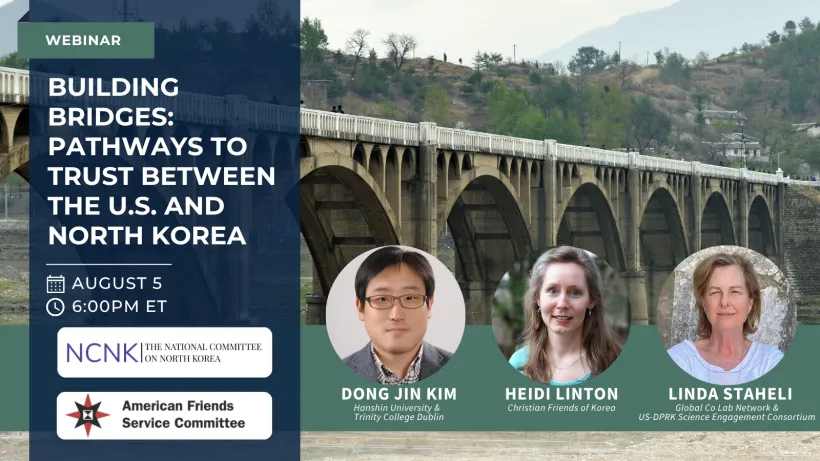
This panel event will delve into the critical challenge of fostering trust amidst a prolonged diplomatic stalemate and deepening mistrust. Drawing on lessons from past engagement and exploring current barriers, the discussion will highlight practical avenues for re-engagement, including humanitarian cooperation, collaborative research, and sustained dialogue. Panelists Heidi Linton, Dong Jin Kim, and Linda Staheli will share their experience and perspectives on the role of trust in advancing both humanitarian efforts and diplomatic progress between the two nations.
About the Speakers
Dong Jin Kim is the Kim Dae Jung Chair Professor of Peace Studies at Hanshin University, and Adjunct Professor at School of Religion, Theology, and Peace Studies, Trinity College Dublin. He was Irish School of Ecumenics Senior Research Fellow in Peace and Reconciliation Studies, Irish Research Council and Marie Curie Fellow at Trinity College Dublin, and Lecturer of Peace Studies and International Development at the University of Bradford. His research interests are in the areas of peace processes, peacebuilding, humanitarian, and development cooperation. He conducts engaged research, collaborating with various humanitarian, development, and peace organisations, including Okedongmu Children in Korea, Korean Sharing Movement, Understanding Conflict Trust, and Corrymeela. He was a Goodwill Ambassador for Peace on the Korean Peninsula at the South Korean Ministry of Unification (2020-22). He is the author of The Korean Peace Process and Civil Society: Towards Strategic Peacebuilding, co-author of Peace and Conflict in a Changing World: Key Issues in Peace Studies, and co-editor of Reconciling Divided States: Peace Processes in Ireland and Korea. He has published numerous research articles in international journals including International Affairs, International Peacekeeping, Globalizations, Peacebuilding, Alternatives, Asia Europe Journal, and the Pacific Review, as well as several Korean peer-reviewed journals.
Heidi Linton has worked with Christian Friends of Korea since its founding in 1995 and began serving as Executive Director in 2002. CFK has delivered over $98 million in aid into North Korea; work prior to COVID is focused primarily on delivering humanitarian and developmental aid related to prevention, treatment and capacity building within the national tuberculosis and hepatitis treatment systems. CFK’s projects include installing gravity-fed solar-powered clean water systems, passive solar greenhouses and training, operating room and solar-powered laboratory renovation projects, transportation and agricultural support projects, as well as ongoing basic humanitarian support (food/medicine, etc.) within the context of relationships and trust-building. CFK, together with Stanford University School of Medicine jointly developed the National TB Reference Laboratory beginning in 2009 and continued ongoing technical assistance efforts. Working together with international and local partners, CFK launched a hepatitis B diagnostics and treatment program in DPRK in 2016 that had, by the end of 2019, screened nearly 3,000 patients and initiated treatment for over 2,000 patients. Heidi Linton served on the leadership team for the USNGO USAID-sponsored food aid program of 2008-09, and CFK also participated in the USAID NGO flood relief effort of 2011-12. Prior to the DPRK's extended border closure, Heidi regularly led quarterly CFK visits to North Korea to confirm the arrival of shipments, continue training efforts, and complete technical projects while building relationships and trust. She has made over 61 visits to the country, including travel to every province. Heidi received her BA from the University of Washington and an MS from New York University.
Linda Staheli is founding Director of the Global Co Lab Network, a global non profit based in Arlington VA, which focuses on empowering the next generation of global change makers addressing the UN Sustainable Development Goals. At the Co Lab she directed and produced A Peace of Science: Diplomacy with North Korea. Prior to this for twenty five years she managed global science engagements, coordinated science diplomacy policy and initiatives working for a number of gov and private sector orgs including the White House, State Department, National Institutes of Health and CRDF Global, where she cofounded and led the US-DPRK Science Engagement Consortium. From 1982-1990 she focused on national security studies for Target Seattle/Metrocenter, Council for a Livable World, and Pacific Sierra Research Corporation. Linda has served in various volunteer capacities, including co-President of Women in International Security (WIIS) and the Global-Health Education Low Cost Publications (HELP) Advisory Board. She has an M.A. in Public Management with a focus on national security studies from the School of Public Affairs, University of Maryland, and a B.A. in International Studies from the Jackson School of International Studies, University of Washington in Seattle.