
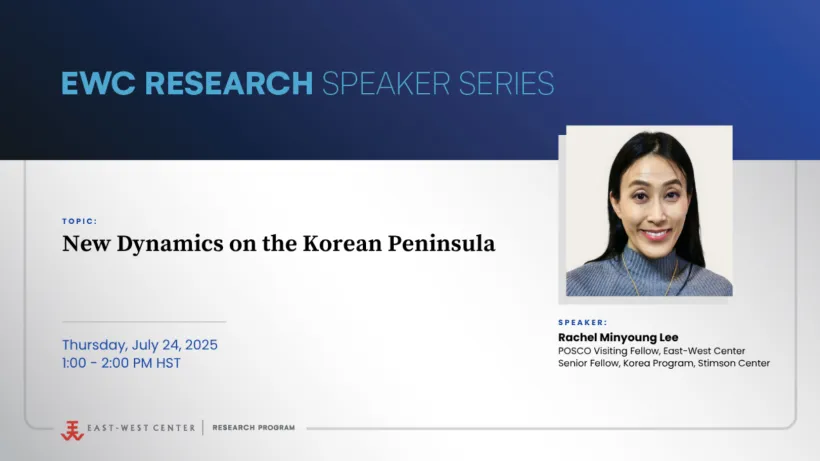
Register: https://www.eastwestcenter.org/events/new-dynamics-korean-peninsula
Thursday, July 24, 2025
1:00-2:00pm HST
7:00-8:00pm ET
The Korean Peninsula’s security landscape is undergoing profound shifts, shaped by changes in leadership and foreign policy in key stakeholder countries. In a bold move, North Korea has abandoned its three-decade foreign policy of normalization of relations with the United States through denuclearization, and nonalignment with China and Russia. Perhaps more dramatically, Kim Jong Un renounced his forefathers’ unification line, adopting a new “two Koreas” policy and rejecting peaceful unification instead. These profound shifts in Pyongyang coincide with leadership turnovers in both Washington and Seoul. The return of Donald Trump to the White House and the election of a progressive president in South Korea have fueled questions around the feasibility of renewed US and South Korea engagement with North Korea. However, Pyongyang’s changed strategic calculus amid geopolitical realignments poses a bumpy road ahead. In that vein, this roundtable will explore three interrelated themes: North Korea’s foreign policy reorientation and its potential regional implications, the prospects for Trump-Kim engagement, and the future of inter-Korean relations under South Korea’s new president.
Rachel Minyoung Lee is a POSCO Fellow with the East-West Center in Hawaii and a Senior Fellow for the Stimson Center’s Korea Program and 38 North. She is also co-chair of the North Korea Economic Forum, which is part of the policy program at the George Washington University's Institute for Korean Studies. Lee was a North Korea collection expert and analyst with Open Source Enterprise (OSE; formerly known as Open Source Center) in the US government from 2000 to 2019. During that time, she wrote on the gamut of North Korean issues, from leadership, domestic politics and economy, and foreign policy, to social and cultural developments. As Analysis Team Lead, Lee led a team of collection officers and analysts to track and analyze North and South Korean issues with implications for Pyongyang’s regime stability and regional security.