
Featuring:
Mr. Joshua H. Pollack,
Editor of the Nonproliferation Review; Senior Research Associate, James Martin Center for Nonproliferation Studies (CNS) at the Middlebury Institute of International Studies (MIIS)
Dr. Ferenc Dalnoki-Veress,
Scientist-in-residence and Adjunct Professor, James Martin Center for
Nonproliferation Studies (CNS) at the Middlebury Institute of International Studies (MIIS)
Dr. Kee B. Park,
Director, Korea Health Policy Project, Lecturer on Global Health and Social Medicine, Harvard Medical School
TUESDAY, December 21, 2021
3:00 pm - 4:15 pm EST
Virtual Webinar via Zoom
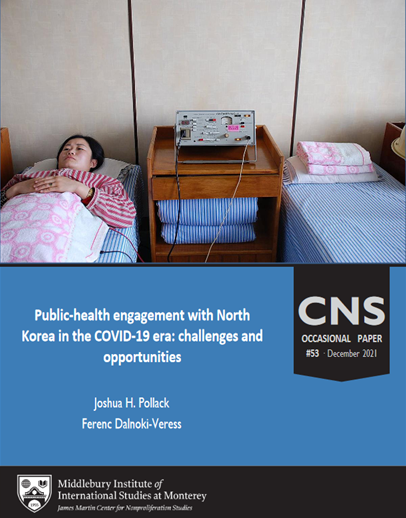
The effective closure of North Korea’s borders to travel and commerce since the early 2020s in response to the COVID-19 pandemic makes it almost impossible for North Koreans to interact and exchange perspectives with the outside world. This situation is contrary to the interests of North Koreans and the international community alike. A new program of humanitarian aid will be needed to permit a safe reopening, and potentially also to address the human consequences of the protracted closure. In a new report on public health engagement with North Korea published by the James Martin Center for Nonproliferation Studies (CNS), Joshua Pollack and Ferenc Dalnoki-Veress review North Korea’s management of epidemics, the conditions of its health systems, and some of the practical problems that sanctions have created for the supply of humanitarian assistance.
Please join the National Committee on North Korea for a public discussion with Joshua Pollack and Ferenc Dalnoki-Veress of the James Martin Center for Nonproliferation Studies and Dr. Kee Park of Harvard Medical School on the findings of the new CNS report and public health engagement with North Korea.
Register here: https://us02web.zoom.us/webinar/register/WN_B0BhIgz8SoKc70LOMqLx-w
About the Speakers
Joshua H. Pollack is the editor of the Nonproliferation Review and a senior research associate at the James Martin Center for Nonproliferation Studies (CNS) at the Middlebury Institute of International Studies (MIIS), and is recognized as a leading expert on nuclear and missile proliferation, focusing on Northeast Asia. Before joining MIIS in April 2016, Pollack served as a consultant to the US government, specializing in issues related to weapons of mass destruction, including proliferation, arms control, and deterrence. As a defense policy analyst at DFI International, Science Applications International Corporation, and Constellation West, his clients included the Defense Threat Reduction Agency, the Office of the Under Secretary of Defense for Policy, the Department of Homeland Security, the National Nuclear Security Administration, and the Plans and Policy Directorate (J5) of US Strategic Command. In 2015, he was named an associate fellow of the Royal United Services Institute. Pollack is a frequent commentator in major media outlets, including CNN, The Washington Post, The New York Daily News, Reuters, Vox, Asia Times, Voice of America, NPR, and others.
Dr. Ferenc Dalnoki-Veress is a scientist-in-residence and adjunct professor. Previously he worked at the Max Planck Institute for Nuclear Physics in Heidelberg, Germany, the Laboratori Nazionali del Gran Sasso in Italy, as well as at Princeton University’s Physics Department, specializing on rare signal detection, primarily neutrino detection. He was a member of the SNO Collaboration that won the 2015 Nobel Prize in physics and is a laureate along with his team of the 2016 Breakthrough Prize in Physics. He was Principal Investigator at CNS of the Centers for Disease Control and Prevention funded project CalPrepare in collaboration with U.C. Berkeley School of Public Health to enhance the California local health departments preparations for emergencies. At the Institute, he focuses on the proliferation of fissile materials, nuclear spent fuel management, emerging technologies and verification of nuclear weapons as well as public health. He co-authored the book Nuclear Choices for the Twenty-First Century A Citizen’s Guide, MIT Press, 2021. He has contributed to more than 40 articles in refereed and non-refereed journals.
Dr. Kee B. Park is a member of the faculty at Harvard Medical School where he studies the complex geopolitical factors influencing health in North Korea and the relationships between international security, health, and human rights and health diplomacy. His recent publications include “The Human Cost of UN Sanctions and Funding Shortfalls for Humanitarian Aid in North Korea” and “Injuries in North Korea: Addressing a Looming Crisis.” Dr. Park is the Director of the North Korea Program at the Korean American Medical Association. Since 2007, he has visited North Korea over 20 times to support the North Korean doctors. His last visit was in November, 2019. He is a member of the National Committee on North Korea and the Council of Korean Americans. He also serves on the Expert Panel on Surgical Care at the World Health Organization in Geneva. He has appeared on PBS, CBC, Arirang TV, CNA and cited in the New York Times, Washington Post, and the Wall Street Journal. He received his MD from Rutgers Medical School, MPH from Harvard Chan School of Public Health, and neurosurgical training at Temple University Hospital. He is a Diplomate of the American Board of Neurological Surgery.