
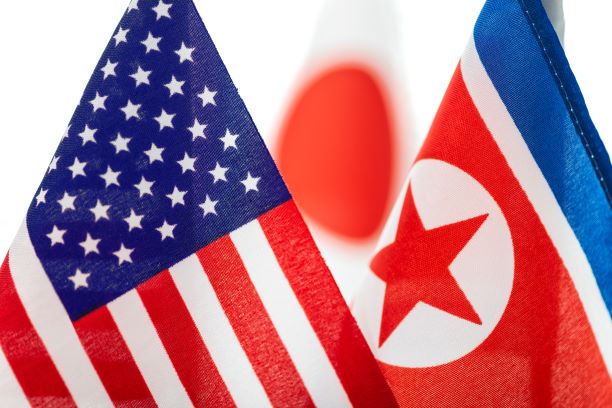
The National Committee on North Korea and the Carnegie Endowment for International Peace will host a webinar discussion of the U.S. Japan alliance and its role in addressing the North Korean nuclear challenge, featuring former Japanese Vice Foreign Minister Mitoji Yabunaka and Sheila A. Smith, Senior Fellow for Japan Studies at the Council on Foreign Relations. James Schoff, Senior Fellow in the Asia Program at the Carnegie Endowment for International Peace, will moderate the conversation.
As the new administration of Yoshihide Suga in Japan prepares to work with either a new Biden or revamped Trump administration, Tokyo faces an array of regional challenges, from a tense bilateral relationship with South Korea to an increasingly assertive China. High amongst these challenges is the threat of a nuclear-armed North Korea, which has developed an increasingly sophisticated array of missiles that can threaten Japanese territory. Prime Minister Suga has declared his willingness to meet with North Korean leader Kim Jong Un, and has emphasized the importance of resolving the issue of past abductions of Japanese citizens by North Korea as well as the need to address Pyongyang's nuclear program. Prime Minister Suga's predecessors have been frustrated in their efforts to make progress along these fronts—and at times coordinating with U.S. administrations—but could the changing geopolitics of Northeast Asia and possibly a new U.S. president open up new possibilities?
Register here: https://us02web.zoom.us/webinar/register/WN_AlLJhxi7QCOeleiYVnX7yg
Speakers
Professor Mitoji Yabunaka entered the Ministry of Foreign Affairs (MOFA) in 1969 and served at the Embassy of Japan in South Korea, Indonesia and the US. After becoming Director of the Second North America Division, North American Affairs Bureau (specializing in US-Japan economic friction), he worked as Senior Researcher at the International Institute for Strategic Studies (IISS) in London. Subsequently, he became the Counselor at the Permanent Mission of Japan in Geneva.
In 2002, he was appointed as the Director-General of the Asian and Oceanic Affairs Bureau and took on the role of Chief Representative of the Japanese Government at the Six-Party Talks on the North Korea nuclear issue. He then became the Deputy Minister for Foreign Affairs and served as a G8 summit Sherpa. He also became the chief negotiator of the Economic Partnership Agreement with Indonesia, Malaysia, and Thailand. In 2008, he was appointed as the Vice-Minister for Foreign Affairs. Since his retirement in 2010, he has become a Professor at the Ritsumeikan University and Osaka University.
Sheila A. Smith is senior fellow for Japan studies at the Council on Foreign Relations (CFR). An expert on Japanese politics and foreign policy, she is the author of Japan Rearmed: The Politics of Military Power, Intimate Rivals: Japanese Domestic Politics and a Rising China (released in Japanese as 日中 親愛なる宿敵: 変容する日本政治と対中政策), and Japan's New Politics and the U.S.-Japan Alliance. She is also the author of the CFR interactive guide Constitutional Change in Japan. Smith is a regular contributor to the CFR blog Asia Unbound and a frequent contributor to major media outlets in the United States and Asia. Smith joined CFR from the East-West Center in 2007, where she directed a multinational research team in a cross-national study of the domestic politics of the U.S. military presence in Japan, South Korea, and the Philippines. She was a visiting scholar at Keio University in 2007-08, where she researched Japan’s foreign policy towards China, supported by the Abe Fellowship.
James L. Schoff is a senior fellow in the Carnegie Asia Program. His research focuses on U.S.-Japan relations and regional engagement, East Asian security, and alliance collaboration in high-tech fields. Before joining Carnegie in 2012, Schoff served as senior adviser for East Asia policy at the U.S. Office of the Secretary of Defense, where he was responsible for strategic planning and policy development for relations with Japan and the Republic of Korea. He also spearheaded extended deterrence dialogues and contributed to trilateral security cooperation initiatives. Schoff’s publications include “U.S.-Japan Technology Policy Coordination: Balancing Technonationalism with a Globalized World” (Carnegie, 2020), Uncommon Alliance for the Common Good: The United States and Japan after the Cold War (Carnegie, 2017), and Tools for Trilateralism: Improving U.S.-Japan-Korea Cooperation to Manage Complex Contingencies (Potomac Books Inc., 2005).